Showing posts with label architecture. Show all posts

11.26.2014

things successful architects do


Neat article at Houzz by an architect on what architects (and designers do).

In short:


  • They tell a good story
  • They take risks
  • They sweat the details
  • They simplify
  • They establish order
  • They repeat, repeat, repeat
  • They break the rules
  • They engage the senses 

11.12.2014

burgers (with a side of architecture)

Below is an article I wrote for the neighborhood newsletter that they recently published. They changed the title to "Of Burgers and Burgertecture" for some reason. Enjoy!


We are, dear neighborfolk, amidst a burger renaissance, the likes of which haven’t been seen since the golden age of burger shacks some seventy years ago. And Burnet Road is partaking in the largess with several new spots as well as a few reworked stalwarts. With the burger wars heating up, the patty-slingers are attempting to differentiate themselves not only with their sides but with their buildings as well.

The beginning of the burger is a topic of sizzling debate, but most agree that the modern era of the burger, and fast food in general, started with White Castle in 1921 in Wichita, Kansas. Krystal imported the slider concept to the south in 1932. However, the boom of burger culture hit its apex in the 40s and 50s with the creation of Fatburger (1947), McDonalds (1948), In-N-Out Burger (1948), Whataburger (1950), Jack in the Box (1951), and Burger King (1953). Coming later were Sonic (1959), Hardee’s (1960), and Wendy’s (1969).

The late 40s and early 50s burger boom reflected post-war euphoria and a young back-from-the-war generation leaning eagerly toward the future. Architecture similarly responded with the sudden popularity of what would later be called Mid-Century Modern. Retail reacted with a space-age Jetsons form of Modernism called “Googie”, named after the exuberance of John Lautner’s Googie Coffee Shop built in Los Angeles in 1949. Burger shops similarly wrapped their griddles with Googie to attract attention—and hopefully sales.


The local burger renaissance seems to have started to sizzle in 2005 with P. Terry’s first shop in south Austin. Architecturally, P. Terry’s was inspired by Mack Eplen’s Drivateria in Abilene and its Googie architecture. P. Terry’s ninth shop, a mega-Googie masterpiece by the Michael Hsu House of Architecture (also a denizen of Burnet Road), recently opened up at 8515 Burnet. As P. Terry’s success rises, the Googie-ness of their buildings grow (yet the Fast Food Nation-friendly burgers and fries remain delicious).

Open since 2006, Phil's Icehouse, named after a founder and ably occupying a former filling station repurposed by Michael Hsu, slings up a number of locally-named burgers, including “The Allandale”, a cheeseburger with cheddar, onions, sliced tomato, lettuce, pickles, mayo, and mustard on a toasted sourdough bun. The warmly bricked garage bays provide ample space for ordering and inside seating while the gas pump canopy outside provides respite from the sun while watching the wee ones ride cows.


Started in 2008, the Hat Creek Burger Company (a name inspired by Lonesome Dove) transitioned from trailer to brick-and-mortar by moving into the old Arby’s building at 5400 Burnet. While I was sad to see that enormous Arby cowboy hat sign fade into the sunset (western Googie?), the recent remodel is amazing. Reach Architects sliced the end of the barn-like building like a loaf of bread, setting the “heel” back from the main loaf, creating not only a playscape and outdoor patio but a screen against the hot Texan sun. All in all Hat Creek is a great contemporary place to eat an avocado-topped turkey burgers with a side of fried pickles.


Hopdoddy Burger Bar (a fusion of “hop” from beer crafting and “doddy” from what the Scots in Aberdeen call their native moo-ers) started in 2010 and opened their second shop at 2438 West Anderson Lane. Hopdoddy slings deliciously messy gourmet burgers in a sleek and chic (yet toasted-bun warm) Modern shell. Levy Architects won an award from the Austin Chapter of the American Institute of Architects for the reuse and redesign of the site (anybody remember the dreadful strip that housed Souper Salad?).

Hill-Berts, an Austin institution since 1973, wasn’t allowed to renew its lease in the gettin'-hipped-up Centennial Shopping Center at 7301 Burnet. The Food Network-featured Twisted Root Burger Company, started in the Deep Ellums of Dallas in 2005, will take its place after a remodel, completing a restaurant trifecta at the Center that includes Teriyaki Madness and Tacodeli (apparently only “T” restaurants are allowed in the revamped Center…). Twisted Root, a name inspired by a cranky hand-cranked French fry cutter, pitches gourmet burgers (including vegan and game) as well as adult shakes (Hear ye! Hear ye! Shakes with liquor!!!). Michael Hsu, the aforementioned master of repurposing and restaurant design, has hipified the tired 1980s architecture of the Center, but one of the owners of Twisted Root, Jason Boso, is taking the lead on reworking the old Hill-Berts building.

Are you really a burger joint if your butterfly roof yelps "FRIED CHICKEN"?

Speaking of local oldtimers (and one that hasn’t been run off), Top Notch Hamburgers at 7525 Burnet started in 1970 and still sports its Googiesque street sign and Mid-Century Modern butterfly roof over the drive-in. Featured in Richard Linklater’s “Dazed and Confused”, Top Notch nearly closed twice after the original proprietors died before being saved by the owners of Galaxy Café. Despite the Galaxians adding Sunday hours and accepting credit cards, the place is oldskool through and through and still serves its straight-ahead delicious aburgers and chicken.


There are, of course, other burger joints in the neighborhood (Billy’s, Waterloo Icehouse, Big Daddy’s Burgers and Bar, Elevation Burger, Short Stop, Jack in the Box, Whataburger); however, none of these sport burgertecture that is particularly inspiring. Sonic continues to vaguely employ 1950s Googie in its stores, and the McDonalds at 7950 Burnet remodeled several years ago back into its early Googie roots.


Architecture doesn’t make a burger taste better, but as P. Terry’s notes: “…we think [our architecture] makes for a better dining experience.” I wholewheatbunheartedly agree. So the next time you head out for a burger, just say no to the fries, sit down, and look around. Have a side of architecture instead. Fewer calories (and hopefully no heartburn!).

11.08.2014

What is Modern 10. Rules are meant to be broken

Frank Gehry beach house in LA area

Rules schmules! Modernism was born during a time of manifestos and the pursuit of "purity", much of it ultimately ridiculous (pilotis, anyone?). In the grand scheme of things, architectural style is not life and death (except, you know, the engineering side of things). Even the "masters" moved away from their manifestos, because manifestos long in the tooth kill creativity. When everyone is doing everything the same, where is the art? Modernism was born from a rebellion against the old ways, so it was only a matter of time before the rebels rebelled against the rebellion (which led to regionalism and, sadly, post-Modernism...).

But breaking rules doesn't necessarily mean throwing all the rules out the floor-to-ceiling window. A building can still be Modern (or at least Modernistic) with tasteful steps away from the playbook.

Lack of Ornamentation: Mies van der Rohe upset the purists by including non-functional I-beams as mullions on the outside of his buildings. He included them because he felt the buildings didn't look right without them. Nevertheless, they are still considered Modern masterpieces.


Form follows function: This commandment, a rebellion against force-feeding function into a predetermined symmetrical design, generally leads to volumetric asymmetry. However, the key building designed by the godfather of perfected Modern, Le Corbusier, force fed function of his most important house, Villa Savoye, into a symmetrical facade (symmetrical from all four sides!).

"Damn the function: Full symmetry ahead!"

Honesty in materials and design: All of architecture is a lie to a certain degree, so it's easy to fib here. The aforementioned Villa Savoye is made of brick with a plaster overlay to achieve the machine aesthetic. How honest is that?

Embracing the environment: My favorite contemporary architecture comes from the urban infill houses of Japan. These houses turn their backs on an admittedly unwelcome environment look inward. These houses stay at home and watch Netflix on Friday night.


Eager adoption of new materials and technology: You can be oldskool in your materials and tech and still be Modern.

A place for everything and everything in its place: One can (such as we have) include ephemera in a Modern house.


A focus on the human condition: Sometimes you have to compromise for the architecture...

Less is more: Sometimes more is more.

Use of the machine aesthetic: Modern can be warm yet still "look" Modern.

Although we have a preference for "classic" Modern, it's your house. Do what floats your boat!


11.01.2014

What is Modern 9: Use of the machine aesthetic


As I put this list of Modern commandments together and reflected on it, I realized that many of these commandments have been (thankfully) assimilated by many other architectural genres through the years such that one could adhere to the first eight commandments and have a house that doesn’t “look” Modern. For example, a contemporary Craftsman house, such as the one around the corner, meets all the “commandments” of Modern discussed thus far:
  • lack of ornamentation: check (there a wee bit, but it's wee)
  • form follows function: check
  • honesty in materials and design: check
  • embracing the environment: check
  • eager adoption of new materials and technology: check
  • a place for everything and everything in its place: check
  • a focus on the human condition: check
  • less is more: check (there's a wee bit "more", but it's wee)
Some of these are checked because of what arts and crafts represents and others are checked because of the assimilation of Modern tenets into an older architectural style. But is that house big m Modern? No. And here’s where style and the machine aesthetic comes in.

The Machine Aesthetic...

The early Modernists vehemently rebelled against classifying Modern as a style. They saw Modern, not incorrectly, as a new way of thinking about architecture, not a style to be disposed of when it fell out of fashion. However, Modern definitely adopted its own aesthetic: smooth surfaces, flat roofs, walls of glass, metallic sheens, and manufactured perfection. This is the machine aesthetic of early Modern. As Modern grew, it loosened the aesthetic dogma, but you know a Modern house when you see one (although there’s a continuing debate over what is Modern and what is Contemporary; more on that later). Like it or not, O Classic Modernists, Modern is a style as well as a new way to think about architecture.

In the 1930s, Henry-Russell Hitchcock dubbed the new architecture the “International Style”. Although Modern architects of the time hated that he did this, he was absolutely correct. Modern was indeed a style, and it was international, arguably the first international style. Hitchcock and Philip Johnson served to further define and restrict the style, which influenced subsequent work if the architectural adherents wanted to be “in the club”. And architects generally wanted to be in the club because being in the club meant recognition and important commissions. This was unfortunate because Hitchcock and Johnson were more about aesthetics (they worked for the Museum of Modern Art, after all) than function. Frank Lloyd Wright, R.M. Schindler, and others of their ilk continued to do their own thing, but even they were influenced by the critics’ barbed tongue (see Wright’s Fallingwater and much of Schindler’s late 1930s work).

Old style and new style...


As far as Modern versus Contemporary goes, my opinion is that if a building meets the “commandments” listed thus far, it is Modern. Some suggest Modern only existed for a defined period of time back in the day and everything afterwards is Contemporary (or some later-defined sub- or post-style). Others further restrict Modern by color (it has to be white) and materials (no natural materials). However, this neglects that most of the earliest Modern structures had color (see Le Corbusier) and natural materials (see Ludwig Mies van der Rohe). Architects that take a full step away (or skydive out of the plane) from one or more of these commandments perhaps become Contemporary. For example, Frank Gehry is not a Modernist. His buildings are transcendental and inspiring, but there’s so much structural ornamentation that he’s more of a neo-expressionist (and lately a deconstructivist) than a Modernist. Or perhaps he’s just Contemporary. We need Hitchcock and Johnson to tell us what’s what…

What would Hitchcock do?

10.25.2014

What is Modern 8: Less is more


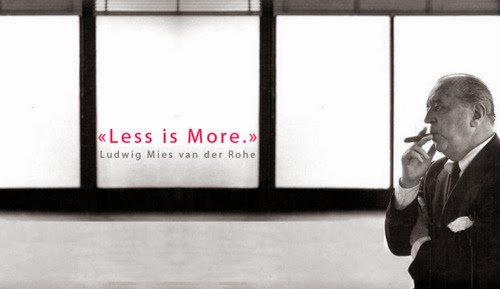
Mies van der Rohe is credited with saying “Less is more”. By this, he was referring to minimalism in design and construction. Modern is not fussy and busy. Modern is clean and calm. Mies fretted over every detail and carefully shaved his designs with Occum’s Razor. If it didn’t need to be there, it didn’t need to be there. He found beauty in the simple and precise execution of basic materials. And he carefully thought out every design element down to the smallest of details. In fact, he also said “God is in the details”.

Minimal baseboard detail via BUILD LLC

Ironically, the corollary to “Less is more” is “Less costs more”, both in designing and in execution. Not only is God in the details; so is the devil. Shouldn’t simple cost less? Seems like it, but simple sadly costs more. Simple details executed flawlessly require conscientious building from the ground up. That requires a master builder and a hovering architect ensuring that everything is as perfect as possible from the outset. And that costs money. Big money. As one architectural firm has noted, flawlessness adds at least 40 percent to the cost of the build depending on the level of desired perfection. Many of today’s (and yesteryear’s) building techniques are meant to hide flaws (think of baseboards and rough-finish drywall) and thus decrease costs because less-trained people can be used to build. Pure Modern requires a different approach, but “Less is more” also applies to more affordable Modern.

Mies's Farnsworth House


“Less is more” also applies to material selection. Rather than mixing and matching a plethora of materials across a house, something commonly seen in traditional houses these days, a consistent application of materials is better. For example, we used the same cabinet and counter-top materials throughout the house including the kitchen, bathrooms, laundry, and even the built-ins in the master bedroom. Some would say this is boring or even odd (as an interior designer told us), but this consistency ties the entire house together and adds to the calmness of the house (and saves having to make material decisions for every room!).

10.18.2014

What Is Modern 7: A focus on the human condition


For some reason, Modernism for many people equates to soullessness, a life devoid of meaning. However, the opposite is true, at least for good Modernism. Part of the reason for this sense may come from Le Corbusier’s “An Architecture” (bastardized into “A New Architecture” by the American publisher). In his early Modernist (and extremely influential) tome, Corbusier famously wrote in 1923 that “a house is a machine for living in”, subsequently (and unfortunately) shortened to “a house is a machine”. This unfortunate shortening is unfortunate because people then assumed, without reading the book, that Corbusier proposed we turn houses literally into machines (and all the unsavory thoughts and gears that come with that proposal). That was not Corbu’s point.

Corbu’s point was that new technology, dominated by engineers and unshackled by design precedents, focused not on how things had been done before, but instead focused on the purpose of what they were designing and then optimized it to that purpose. In almost all cases, the designs accommodated the people they were intended to serve. Corbu noted that cars are machines for driving, that boats are machines for traveling, that sofas are machines for sitting, and that, indeed, houses are machines for living.


Having established that, he then proceeded to identify what makes a house pleasant to live in, independent of how houses had been designed before. In this, Corbu includes a “Manual of the Dwelling” enumerating his thoughts on a home:

Demand a bathroom looking south, one of the largest rooms in the house or flat, the old drawing-room for instance. One wall to be entirely glazed, opening if possible on to a balcony for sun baths; the most up-to-date fittings with a shower-bath and gymnastic appliances.

An adjoining room to be a dressing-room in which you can dress and undress. Never undress in your bedroom. It is not a clean thing to do and makes the room horribly untidy. In this room demand fitments for your linen and clothing, not more than 5 feet in height, with drawers, hangers, etc.

Demand one really large living room instead of a number of small ones.

Demand bare walls in your bedroom, your living room and your dining-room. Built-in fittings to take the place of much of the furniture, which is expensive to buy, takes up too much room and needs looking after.

If you can, put the kitchen at the top of the house to avoid smells.

Demand concealed or diffused lighting.

Demand a vacuum cleaner.

Buy only practical furniture and never buy decorative “pieces.” If you want to see bad taste, go into the houses of the rich. Put only a few pictures on your walls, and none but good ones.

Keep your odds and ends in drawers or cabinets.

The gramaphone or the pianola or wireless will give you exact interpretations of first rate music, and you will avoid catching cold in the concert hall, and the frenzy of the virtuoso.

Demand ventilating panes to the windows in every room.

Teach your children that a house is only habitable when it is full of light and air, and when the walls and floors are clear. To keep your floors in order eliminate heavy furniture and thick carpets.

Demand a separate garage to your dwelling.

Take a flat which is one size smaller than what your parents accustomed you to. Bear in mind economy in your actions, your household management and in your thoughts.

Although Corbu’s flavor of Modern is described as cold, he was truly a humanist, bending his theories at the knees to bow before humanity.

Corbu goes on, somewhat poetically:

Every modern man has the mechanical sense. The feeling for mechanics exists and is justified by our daily activities. This feeling in regard to machinery is one of deep respect, gratitude, and esteem.

Machinery includes economy as an essential factor leading to minute selection. There is a moral sentiment in the feeling for mechanics.

The man who is intelligent, cold and calm has grown wings to himself [blogger’s note: This is stated on a page with photos of airplanes.]

Men--intelligent, cold and calm--are needed to build the house and lay out the town.

In essense, what The Corbu is saying is that the machine ethic, that ethic of the purposeful engineer to design in a practical and cost-effective manner, needs to be brought into the design of our homes and cities.

However, Corbu recognizes that architecture is not simply cold and practical design:

You employ stone, wood and concrete, and with these materials you build houses and palaces; that is construction. Ingenuity is at work.

But suddenly you touch my heart, you do me good, I am happy and I say: “This is beautiful.” That is Architecture. Art enters in.

My house is practical. I thank you, as I might thank Railway engineers or the telephone service. You have not touched my heart.

But suppose that walls rise towards heaven in such a way that I am moved. [...] That is Architecture.

Although practical design can accidentally lead to beauty (see grain silos), it’s best not to leave beauty to accident:

Architecture is the skilful, accurate and magnificent play of masses seen in light...

Corbu went on to note that the Modern age, the transfer of people from rural to urban areas, from working in a field with family to working in a factory with the faceless, threatens family fabric which in turn threatens civilization. He noted that architecture at a home or city scale can be used to offset these threats, maximizing family interaction and interaction with nature, basic needs of our species. And he further noted that if these basics needs are not met we risk social unrest and the ruin of civilization.

With the exception of certain neighborhoods in California, especially in Los Angeles, and in certain places across the country for a brief period after World War II, Modernism in home design never really took off in the United States, although certain elements of it, the non-style elements, did. However, big business heartily embraced Modernism through Mies van der Rohe’s glass boxes, probably more because of the efficiency of costs than in concern of the human condition (lack of ornamentation and flexible space = cost savings). Because of this adoption, many people associate Modern with business. Shortly before our house was finished, an elderly gentleman pulled up in his Ford LTD, rolled down his window, and asked: “When will you be open for appointments?” Excuse me? I responded. “I need to get my teeth cleaned. Wondering when you will be open for business.” (He was goofing on me, but this discussion really makes us laugh because there’s a Modern house in South Austin we call “The Dentist’s Office”.)


In short, Modern is extremely accommodating to meeting the needs of the occupants. Depending on the skill and assumptions of the architect (and the budget of the client), success at meeting this goal varies, but Modern is intensely focused on designing pleasant spaces to live and work in. We are not forced to live as they did in the 1600s or 1800s or 1950s, Modern is about living as as we live now.