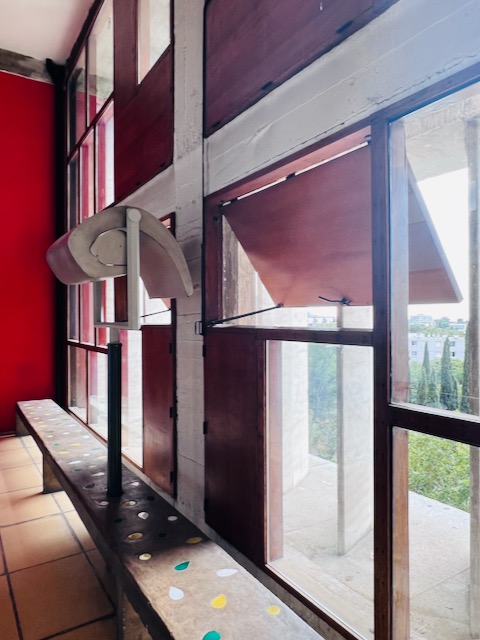
One of Le Corbusier's most influential projects was ‘Cité Radieuse’ in Marseilles, France, designed in collaboration with Nadir Afonso (whose thesis was titled "Architecture is Not Art"). Built between 1947 and 1952, ‘Cité Radieuse’ hosts 337 apartments plus a mixed-use floor. This building, looming and futuristic, is often cited as the initial inspiration for Brutalism.
Le Corbusier was in turn influenced by the sleek, International-style
Narkomfin Building in Moscow designed by
Moisei Ginzburg and completed in 1932. Corbu's original vision for ‘Cité Radieuse’ was steel, but a derth of the metal after World War II caused him to use concrete instead, creating almost insect-like pilotis (a Corbu trademark) underneath the building. Corbu included a community terrace on the roof with views of Marseilles, the Mediterranean, and abstract (and now iconic) structures for the building's ventilation. The rooftop includes a wading pool, a running track, a meeting room, and a stage/concrete screen for movies. The living units featured built-in furniture designed by Charlotte Perriand and Jean Prouvé (who also designed the steel staircases for two-story units).
The design was so well-received that Le Corbusier designed and built four other versions of the building in Nantes-Rezé in 1955, Berlin in 1957, Briey in 1963, and Firminy-Vert in 1965 (and I swear we saw one [a tiny version?] in Paris).
Not everyone loved the design, criticizing unused space under the building. However, we saw that residents kept their bikes out of the weather underneath and could stay out of the sun underneath. Security-wise and (flood-wise), the design is brilliant (and ahead of its time climate-wise). Firstfloorers have the same privacy as upper units as well. But the structure is part of Le Corbu's vision of new-urbanism, which is distant from the city itself (I am reading Jane Jacobs at the moment).
There is a first floor reception area where you access the elevators. Our visit was free but restricted to the business floor (where there's a hotel (!!!), a restaurant, and offices. And then you can access the glorious roof! Well worth a visit. Unfortunately, a unit is not available to gawk at, but it's wonderful that the public can access the public spaces.