9.10.2014

haiku for the book "No Place Like Utopia" by Peter Blake


where the planes dissolve
where inside becomes outside
is utopia

After our house was on the Modern Home Tour, the architects left us a few gifts, and this book was one of them. An interesting read about a dude in the middle of it all such that he knew a number of the architectural movers-and-shakers of the mid-century modern era (as well the early Modernists). He worked with Louis Khan; knew Jackson Pollock, Philip Johnson, and Charles Eames well; was the curator of architecture and design at MoMA; and was editor in chief of the Architectural Forum. He also interacted with Bertrand Russell, Serge Chermayeff, Oskar Stonorov, Hans Knoll, Mies van der Rohe, Buckminster Fuller, Gropius, Rietveld, Marcel Breuer, Gregory Ain, and Neutra.

He had run-ins with Frank Lloyd Wright and said "Frank Lloyd Wright, who lied like a trooper, would have been a bore if he had stuck to the facts." He also said "[Wright] had clearly come to believe that he (or He) was Architecture, and Architecture was Wrightian or it was nothing at all." Blake also noted how poorly Wright treated anyone who worked for him that showed promise, describing Wright as "...always jealous of any talent he thought might threaten his own reputation..."

Blake loved de Stijl neoplasticism ("...one of the noblest and most radical of all modern movements...") and absolutely hated post-Modernism (for this, I love him). He explains why architects of the time hated Modernism being pigeon-holed into a "style",  describing Modernism as "...politically left, anticapitalist, and dogmatically so." Becoming an architect back in those days "...was a commitment to help change the world, nothing less."

And he was an architect who designed some nifty Modern beach houses in the Hamptons (photos below). He also wrote "Form Follows Fiasco", a criticism of Modern architecture (which his friends told him to burn; he seems to have forgotten about the book when he wrote his autobiography...).

All in all a good read with personal insights into the personalities of the big names in Modern architecture. And a good call for a book for me to read!


9.07.2014

(almost...) Collecting the sun!


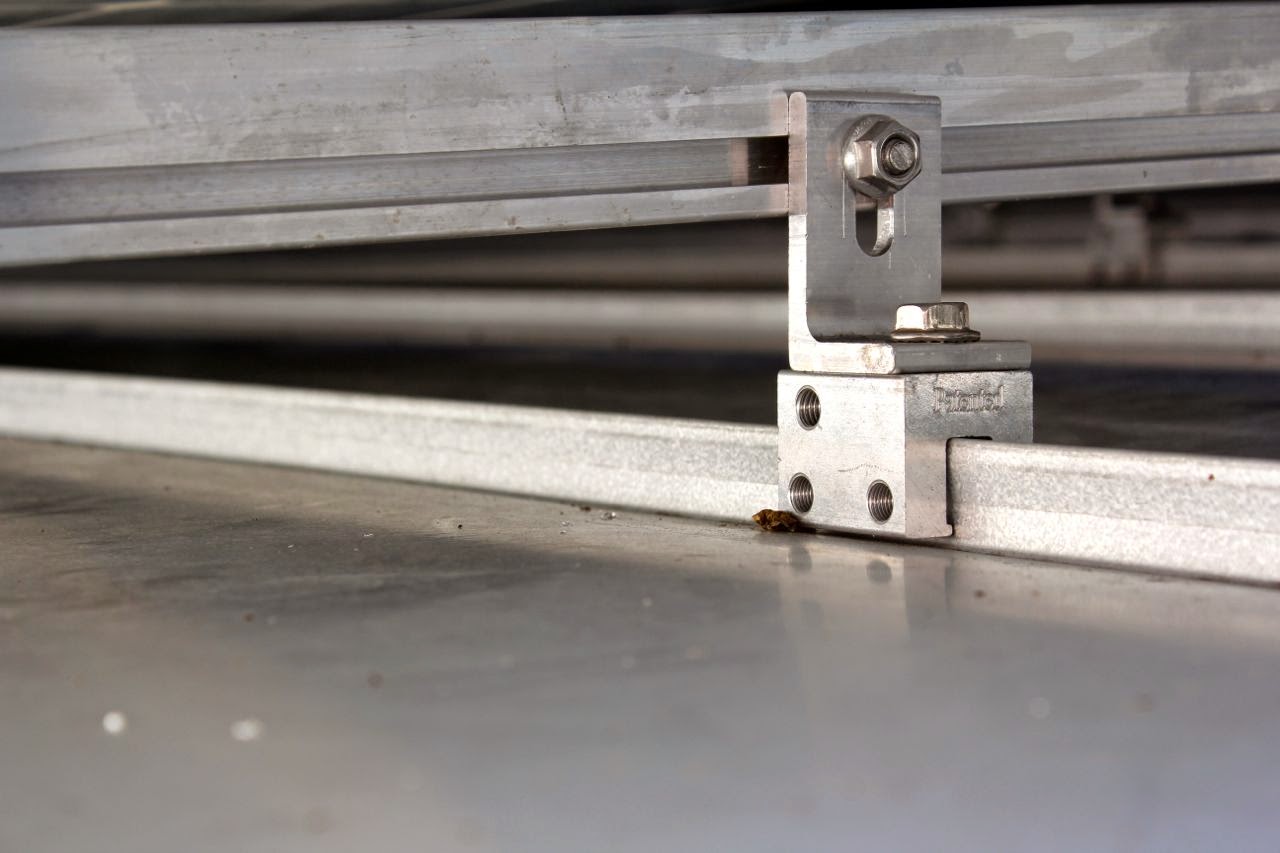
The solar installers came this week and began installing solar panels and associated electrical connections. The above photo is after an afternoon or so of work installing solar panel support structures. Because the roof is clad with standing seam galvalume, it's relatively simple to install the supports by clamping them to the standing seams:


The next morning the installers came out and installed the panels themselves and left behind the inverter for the electrician:


And then either Thursday or Friday the electrician came out and connected the system into our electric box:


You might have noticed that there isn't an electric meter yet: The solar company is waiting for a city inspection (and subsequent meter) before we go live. Yippee!

All in all a nice and clean install. Can't wait to start actually collecting sunlight!

9.06.2014

What is Modern? 2. Form follows function

Part 2 of a 10-part series on what is Modern.

The purity of function in the form of a Midwestern grain silo.

Back in old pre-Modern days of formal architecture, function was often forced to follow form. The form of a building was predetermined (think of the symmetry of Georgian mansions, Greco-Roman structures, Renaissance buildings); function had to find a way to fit form. Inspired in part by midwestern grain silos (Loos and Corbusier were enamored with them), proto-Modernists began experimenting with form deferring to function. This allowed for articulation of surfaces: instead of a flat plane on a building surface, volumes protruded and receded from the plane as internal needs were met.

The forced symmetry of a Georgian mansion.

It was Louis Sullivan in the 1880s who famously uttered “form ever follows function” as part of his practice in Chicago (the modern permutation drops the “ever” for the mantra “form follows function”). It simply means that the bones of a building, in other words, its volumes, reflect what the building is used for rather than trying to force-fit a function into an arbitrary form.

Louis Sullivan. Even his beard
was asymmetrical.


For example, some architectural dogma requires symmetry in a building’s design: the right half needs to look like a mirror image of the left half regardless of the enclosed functions in either half. Modernism has no such requirement (and arguably demands asymmetry). Whatever volumes a structure needs to accomplish its purpose (considering function, lot, zoning, and budget restrictions) is the shape structure takes.

1926, Walter Gropius, haus at the Bauhaus.

9.03.2014

Frank Lloyd Wright's Louis Pennfield House

Love-love-love this house, built in 1955. Currently for sale for a cool $1.7 million (but includes a couple other places). Also currently for rent!


8.31.2014

a modern birdhouse for a modern house


Etsy is a wonderful place. Despite being all crafty and whatnot, there are crafters on there with impeccable design and construction skills to fabricate accessories for the most modern of environments. Our mailbox came from Etsy, as do these birdhouses:


Wanting to install a birdhouse somewhere on the "back forty", the birdhouse we chose is made by HublerFurniture:

via HublerFurniture

Simple cube with nice variation of wood in the front. The design is clever in that the top is solid (no place for water to seep in) and that the house "hangs" off of the back which is attached to the tree (or whatever you want to attach is to).

Here's what we received in the mail:


A work of art, really. Hard for me to not just place it on a bookshelf and call it a day...

Here where we wanted to install it:


This is the window above our bed. The idea is that we can see it when looking out the window.

Installing the removable back of the birdhouse to the tree:


And now with the house slid over the back:


And here it is out the window:


And there you have it! With Austin rents the way they are, we're hoping to pull in $450 a month from our first renters!

8.30.2014

What is Modern? 1. Lack of Ornamentation

Part 1 of a 10-part series on what is Modern.

Rococo (over)ornamentation (photo from Wikipedia)

Lack of ornamentation is key to Modern: Thou shall not adorn thy buildings with puffery. The rebellion against over-ornamentation goes back to the mid-1800s with the likes of William Morris, he in turn inspired by the writings of John Ruskin. Morris and his followers created the Arts and Crafts Movement in architecture (more commonly called Craftsman in the United States) that celebrated the handiwork of the craftsman in contrast to machine-generated lathe work lathered upon the gingerbread Victorians of the time.

The anti-over-ornamentation movement was furthered by Louis Sullivan (who wrote “It could only benefit us if for a time we were to abandon ornament and concentrate entirely on the erection of buildings that were finely shaped and charming in their sobriety.”) and then carried even farther by his one-time understudy Frank Lloyd Wright in the late 1800s. Although Sullivan and Wright railed against ornamentation, they continued to ornament their work (Wright less so than Sullivan) albeit at a greatly reduced level than their contemporaries.

Prudential Building, Buffalo, New York, by Louis Sullivan (photo from Wikipedia)

Adolf Loos, inspired by the quote above from Sullivan, reached the apex of anti-ornamentation, at least theoretically, in 1910 when he provocatively (and entertainingly) equated ornamentation with criminality in a speech and later an essay titled “Ornamentation and Crime”. Loos wrote "To find beauty in form instead of making it depend on ornament is the goal to which humanity is aspiring."  He goes on to equate any kind of ornamentation with degenerate and illicit behavior: “The modern man who tattoos himself is either a criminal or a degenerate.” and “Freedom from ornament is a sign of spiritual strength.”

I wonder what Adolf Loos would think about kids these days...

Rufer House, 1922, by Adolf Loos. Yo, Loos: What's with the frieze?!?!?

Because of Loos, the complete lack of ornamentation became the ideal and a major commandment of Modern architecture. However, even he, perhaps at the bitter behest of clients, included some ornamentation in his buildings. It was the next generation, the true Modernists, that erased ornamentation from buildings completely.

Put quite simply, Modern architecture is not ornamented. This does not mean that Modern architecture is not artful or pleasing to the eye, it’s just that its beauty is in the skin and bones, not the makeup or the jewelry.

A natural beauty.

8.28.2014

Frank Lloyd Wright's cat house

No, no, no: Not that kind of cat house. We're talking truly a house for a cat! More after the jump.