Showing posts with label book. Show all posts

9.23.2017

haiku for the book "Richard Meier" by Claudia Conforti and Marzia Marandola


whiter than flat white
and more Corbu than Corbu
jewels on the landscape...

This is a whisper of a book about our favorite living Modern architect I picked up at Half Price. And even if he wasn't living, he would still be among our favorites. Back when the megalotto approached a billion dollars, we both agreed that commissioning Mr. Meier to design a house for us would be high on our list of splurging.

This book serves as a good introduction to Meier; a taster that will lead to finding the main course. The book has a somewhat brief introduction with photos of some of his works.

Not surprisingly, Meier was born to Germans. He received a degree from Cornell in 1957 and, after finishing two years of military service, toured European architecture in 1959. Upon visiting the Weissenhoff Estate in Stuttgart, he became enamored with the original manifestations of Modernism, particularly those of Le Corbusier. Meier then hightailed it to Paris to seek a position in Corbusier's studio. Sadly, Corbu rebuffed Meier's offer. Later, Meier was able to hold a long conversation with Corbu at the opening of the Cite Universitaire, a meeting that strongly influenced his career (despite Corbu once again rejecting his services). In Corbu's stead, Meier worked with SOM from 1959 to 1960 and with Bauhauser Marcel Breuer from 1961 to 1963 before opening his own studio in 1963. 

Similar to Corbusier, Meier was a voracious painter and shared an art studio with Michael Graves. Just as Corbu infused his architecture with art, Meier concluded that "architecture is an art of substance." Although Meier is clearly influenced by Corbusier--particularly Corbu's manifesto "Towards an Architecture--Meier's designs are much different in materials and in how they engage with people and the environment. In an homage to Corbusier, Meier keeps a model of Villa Savoye in his office.

Some random photos or Meier's work, not necessarily covered in the book:


4.16.2017

1001 buildings you (maybe) must see before you die!


On a whim, I picked up this tome at Half Price Books on Thursday. This thick guide lists (ahem) 1001 buildings to see before you leave this mortal coil. I didn't count to verify, so I'll take the editor's word that there are, indeed, 1001 buildings listed in here. The structures date from the Newgrange Burial Chamber in Ireland from 3200 BC up to Herzog and de Meuron's Beijing National Stadium (known to the locals as 'The Bird's Nest') in 2008.

After flipping through its ample pages, I determined that we've seen 54 of the 1001 buildings. So we've got some work to do (although it will not be our life's goal to see all of these since some choices are questionable and others are in locations that are risky to life and limb).

Page markers for buildings we've seen...

I was happy that an R.M. Schindler made the cut (the Schindler-Chace House), but horrified that the authors included a photo of the Lovell Beach House instead. At first I thought perhaps it was a printing error that mixed up the photos from a later listing of the beach house; however, this is the sole Schindler listing. As the bride helpfully pointed out: Can you really trust an architectural book that doesn't know the difference between the two houses? Good point.

Great photo of the Beach House, though.


At the very least, the book will be helpful in putting together viewlists for various trips we may or may not take.

4.08.2017

haiku for the book "How House: RM Schindler" by James Steele


you ask yourself "How?"
nestled amongst rolling hills.
interlocking joy...

Built in 1925, this remarkable piece of early Modernism is comfortably perched on a Silverlake hilltop, a beacon of radical architectural thought. The author, James Steele, notes in the first sentence of the book that the How House is "..arguably the best house that Rudolf Schindler ever designed...". It is, unquestionably, a beauty. It's also shockingly ahead of its time. Now almost a hundred years old, it could have been designed yesterday.

James Eads How inherited a fortune from his father, James Buchanon Eads, who invented a diving bell that supported a successful salvage company. James Buchanon also designed the ironclad gunboats the North used to defeat the South's navy during the Civil War. After he retired, his restlessness led him to designing and building a steel-superstructure arch bridge in St. Louis, an engineering feat.

After he graduated from Havard Medical School, James Eads How attempted to donate his inheritance to the National Socialist Party, but his family stopped him through the courts. In response, he dedicated his fortune to assisting the homeless.

Given that How's socialist politics brought him through the Schindlers' gatherings at Schindler's own house, Schindler designed a practical house with radical aesthetics, greatly advancing Frank Lloyd Wright's architectural vision.

This 80-page book, published in 1996, is for Schindler diehards, and includes many diagrams and photos as well as a detailed architectural critique. We were fortunate enough to not only tour the house but attend a reception there to hear Judith Sheine speak about the house and Schindler. The place is gorgeous and well-thought out and detailed.


8.27.2016

haiku for the book "Cabin Porn"


lurking in shadows
there is something in the woods
a homemade something

I was prepared to love this book because I love the website and its politically incorrect name. However, I was underwhelmed. The book is a series of vignettes about building cabins in the boonies, including the authors' story. The primary focus of the vignettes is on do-it-yourself outdoorsmen cabin building. Between the vignettes are photos of, presumably, the authors' fave cabins from all over the world.

The vignettes are interesting but oddly dispassionate; oddly oddly dispassionate in the same style as Anais Nin's erotica (for example, see Little Birds) or a biologist describing the dissection of a field mouse. The writing thoroughly describes who and what, but doesn't sparkle. And while I know that river-bottom hardwoods are used to produce those fine glossy photo books you see and that perhaps a book about cabins in the woods shouldn't tax the woods (too much), the rough pages feel cheap and don't adequately convey the photos. There is some Modernism among the pages, but not enough for required reading for an outdoorsy Modernist.

If you want to build your own rustic cabin out in the middle of nowhere, the book may be a good buy. Otherwise, surf the site.

8.20.2016

haiku for the book "Weissenhof 1927 and the Modern Movement in Architecture" by Richard Pommel and Christian F. Otto


go to Weissenhof
to see an amazing set
of Modern houses

This is a remarkable book, but not in the sense of you-need-to-rush-out-and-get-this-damn-thing-as-soon-as-possible but in the sense of where-the-hep-did-these-guys-find-so-much-information. It's clear that Germans don't throw anything away and that they protect their paperwork even during world wars.

Opened in 1927, Stuttgart's Weissenhof is the greatest single collection of early Modern architecture in the world. Chicago is great, Los Angeles is amazing, Paris is pretty in springtime, but for an individual development with nearly all the big names of the time, this is the real deal. Mies van der Rohe, Le Corbusier, Mart Stam, Walter Gropius, Scharoun, Bruno Taut, Max Taut, Behrens, J.J.P. Oud, and others contributed to the exhibition.

Mies van der Rohe was the grand architect of the project, laying out the development, recruiting and fighting for a Modern direction, and designing several of the buildings. When the housing development opened up, more than 500,000 visitors tromped through its streets to see the new architecture for themselves.

The project was a power of wills. The city wanted a humble demonstration of housing with an emphasis on local architect; Mies wanted an avant-garde display of international Modernism. Mies and the avant-garde won.

The project was not without its drama. Mies excluded Adolf Loos from the project, something Loos remained bitter about (although Loos blamed the mayor). The authors speculate that Loos' designs had become embarrassing, such as his goofy Post-Modern-before-there-was-such-a-thing-as-Post-Modern proposal for the Tribune building in Chicago. Loos was too much of a wildcard for the Weissenhof. Mies was attempting to consolidate the movement.

With many different architects designing so many different buildings, Mies needed to link the projects together visually. He did this by encouraging the use of an off-white paint for most of the surfaces with color allowed to highlight distinct parts of the architecture. And many of the architects used color to great effect. Even Gropius, recently influenced by van Doesburg's de Stijl movement, colored his work at the Weissenhof. Nevertheless, white remained the Modernists' color of choice, "...the tabular rasa reshaped only by pure form, space, structure, and function." The unifying use of white at the Weissenhof "led the way in the new direction" in the use of color (or lack thereof) in the International Style.

Besides collecting many of the best architects in a single place for public viewing and establishing white as the non-color of choice for Modernism, the Weissenhof is important for other reasons. For example, Corbusier's villas at the Weissenhof were the "pretext of the announcement" (Corbu's words) for his article "The Five Points of Architecture" (pilotis, roof garden, free plan, ribbon window, and free facade).

After the opening, people expressed concerns about the designs, particularly how open they were on the inside as well as to the outdoors, thus, in the minds of the critics,  presenting a threat to traditional family life. Detractors described the houses and apartments as anti-children because of their clean surfaces and machine-like perfection (echos of these complaints are still heard today). After the exhibition, Stuttgart debated what to do with the buildings. One prominent local stated that the Weissenhof had "produced nothing of aesthetic value". Nevertheless, the city was able to easily rent everything in short order except Corbusier's villas due to concerns that all the natural light and outdoor space would be bad for people's health. Shortly before World War II, the German army considered razing the development to build a base, but thankfully decided on another location.

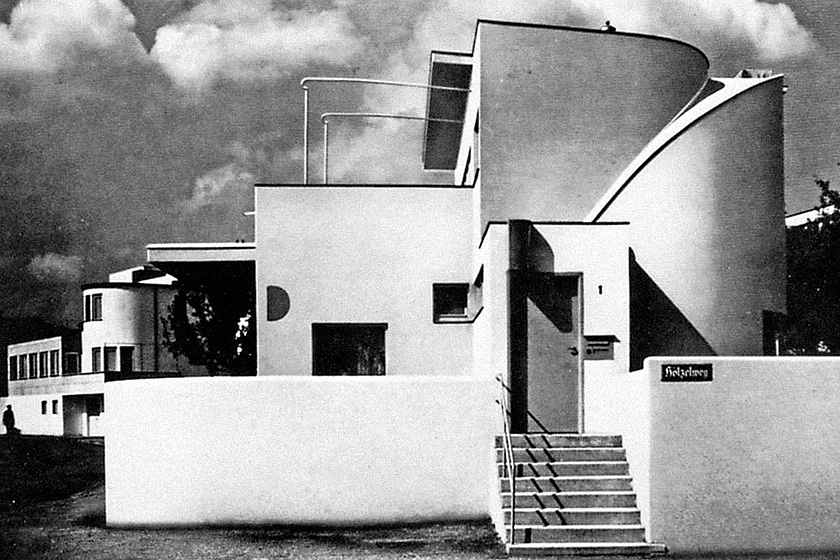
Although the Weissenhof suffered damage during WWII, losing several houses, somehow the bombs missed most of the real gems such as Corbu's two villas and Scharoun's swooping house (perhaps the Gawds are Modernists as well!). Nonetheless, houses by Gropius and the Tauts were destroyed and other greatly modified. Since the war, many of the buildings have been rebuilt or remodeled back to their original plans.

I'm not sure what Mies the Man would have thought about this book, but here's what Mies the Cat thought:


There you go...

In about a month, the bride and I will be in Stuttgart to see the Weissenhof for ourselves. Expect a report back soon!


This Scharoun house is one of my top-ten early-Modern houses.


Detractors of the project produced this postcard poking fun at the Meditteranean influence on Modernism.


One of Corbu's villas


SaveSave

10.17.2015

haiku for the book "A Pattern Language" by Christopher Alexander, Sara Ishikawa, and Murray Silverstein


let us crawl backwards
towards a time of coves and caves
and live in a hole


This book, first published back in 1977, is considered a classic in the architectural oeuvre.
 I'm not sure why. The title comes from how the book is organized, a listing of 253 observations--numbered patterns--of how people like to live, at least from the perspective of the authors. A single pattern may tie into or be associated with several others. Each pattern starts off with a decree followed by a supporting argument about why it is an architectural truth. This is all well and good except that these architectural truths seem to have been written by extra grumpy and exceedingly hairy hobbits fixated on medieval rat-in-a-hole architecture. I half expected to find a pattern titled:
  • Dungeons should be located between four and seven rooms from your master bedroom, far enough away that the screams of your enemies don't keep you up at night, yet close enough that their muffled shriekings lull you to sleep.
That's not to say that the book has no value, but it is a slog, and the gems are far and few between. It's also seemingly somewhat post-Modern in that it is anti-Modern, essentially neo-medieval. However, I did get a chuckle when, after slagging Modernism time after time, it held up the unattributed kitchen from Le Corbusier's Villa Savoye as a good example of a windowed cooking space.

Here are some examples of patterns:
  • There is abundant evidence to show that high buildings make people crazy.
  • Isolated buildings are symptoms of a disconnected sick society.
  • Arrange all toilets over a dry composting chamber. Lead organic garbage chutes to the same chamber, and use the combined products for fertilizer.
  • The presence of children in a family often destroys the closeness and the special privacy which a man and wife need together.
  • Bedrooms make no sense. [this seems to conflict with the previous one...]
  • A building in which the ceiling heights are all the same is virtually incapable of making people comfortable.
  • On no account use standard doors or windows. Make each window a different size, according to its place.
  • People like to watch the street.
  • All people have the instinct to decorate their surroundings.
The authors have socialist if not outright communist tendencies:

  •  Set up processes which encourage groups of 8 to 12 people to come together and establish communal households.
  • Do everything possible to make the traditional forms of rental impossible, indeed, illegal. 
Whatever make your hammer swing, go for it (I say), but this post-hippiness isn't terribly reflective of modern society.

There are, however, patterns that make sense, at least to me:
  • Buildings must always be built on those parts of the land which are in the worst condition, not the best. [sorry Fallingwater...]
  • Unless the spaces in a building are arranged in a sequence which corresponds to their degree of privateness, the visits made by strangers, friends, guests, clients, family will always be a little awkward.
  • If the right rooms are facing south, a house is bright and sunny and cheerful; if the wrong rooms are facing south, the house is dark and gloomy. [Northeastern bias expressed here...]
  • Arriving in a building, or leaving it, you need a room to pass through, both inside the building and outside it. This is the entrance room.
  • When they have a choice, people will always gravitate to those rooms which have light on two sides, and leave the rooms which are lit only from one side unused and empty.
  • Balconies and porches which are less than six feet deep are hardly ever used.
  • There is no substitute for fire.
  • Except in very large rooms, a door only rarely makes sense in the middle of a wall. It does in an entrance room, for instance, because this room gets its character essentially from the door. But in most rooms, especially small ones, put the doors as near the corners of the room as possible. 
  • Dark and gloomy kitchens are depressing. The kitchen needs the sun more than the other rooms, not less.
  • The slab is the easiest, cheapest, and most natural way to lay a ground floor.
  • Surround any natural outdoor area, and make minor boundaries between outdoor areas with low walls, about 16 inches high, and wide enough to sit on, at least 12 inches wide.
  • Make a place in the house, perhaps only a few feet square, which is kept locked and secret; a place which is virtually impossible to discover--until you have been shown where it is; a place where the archives of the house, or other more potent secrets, might be kept.
And there's some stuff that is completely alien to a Modernist:
  • If there is a beautiful view, don't spoil it by building huge windows that gape incessantly at it. Instead, put the windows which look onto the view at places of transition--along paths, in hallways, in entry ways, on stairs, between rooms. If the view window is correctly places, people will see a glimpse of the distant view as they come up to the window or pass it; but the view is never visible from the places where people stay.
Seriously?
  • Houses with smooth hard walls made of prefabricated panels, concrete, gypsum, steel, aluminum, or glass always stay impersonal and dead.
  • A first principle of construction; on no account allow the engineering to dictate the building's form.
  • When plate glass windows became possible, people thought that they would put us more directly in touch with nature. In fact, they do the opposite. [here they propose multi-paned glass]
Associated with the floorpan of Mies van der Rohe's Farnsworth House:
  • The perfectly crystalline squares and rectangles of ultra-modern architecture make no special sense in human or in structural terms. They only express the rigid desires and fantasies which people have when they get too preoccupied with systems and the means of their production. 
Unless you are an architectural diehard, I would not recommend acquiring this book. However, the concept of identifying and collecting patterns or certain "truths" (although there is no truth...) is alluring. For example, why isn't there a pattern language for Modernism?

The inspiration for reading this book was the mention of it at a water meeting held at Wingspread. Developing a pattern language for water conservation, a concise summary of what we (think) we know can be useful, even if some (if not everyone) disagrees. At least a list of thoughts like this allow ideas to percolate to help you decide what are the best patterns for you and your people.

9.02.2015

haiku for the book "The Perfect $100,000 House" by Karrie Jacobs


one hundred thousand...
is it even possible?
at this time and place?

I clicked this book up in a weak moment during my tequila-fueled frenzy to learn more about Rocio Romero's LV house. The next morning, regret washed in: "I can't believe I bought a book simply because it mentions Rocio Romero..." But after Karrie Jacobs' The Perfect $100,000 House came and after I, yes, skipped to and read the Romero chapter, I started the book from the beginning and read it clean through. It is an absolute gem.

The book is like Jack Kerouac's On the Road fused with Dwell but without the drug use (and the underaged sex south of the Tropic of Cancer [although I suspect there was some rolling around in the hay {bale house}...]). Jacobs had just left her job as the founding editor of Dwell under something of a dark cloud and then, freed from any obligations and back into the freelance world, traveled 150,000 or so miles across the U.S. in search of a $100,000 house, the amount she could afford. Mind you, this is in the Early Aughts (circa 2003), so a hundred grand today ain't what it used to be (according to the feds, $100,000 then would be $130,000 today, still a modest amount for a new house). Nonetheless, the book's focus is really on accessing good design at an affordable cost.

What she discovered was that being affordable required cheap land (of course), conventional building techniques (although there are exceptions), sweat equity, modularity (although there are cost challenges), and an architect willing to assume little to no compensation for the task (or have that compensation spread out over multiples). As one of the Andersons of Anderson Anderson Architecture states: "The least expensive house is the most conventional one." The clean look of Modern costs money, making an inexpensive Modern house highly difficult.

I was pleased she made a stop in Marfa. She points out that Donald Judd, despite a fixation on cubism in his art and furniture, placed curving roofs on his buildings. She then stopped in Austin to visit with Chris Krager of KRDB and describes a house friends of ours built in South Austin: 1,400 square-feet for $125,000. KRDB's work is Schindleresque in that KRDB works with the standard materials of construction: wood and stucco (Krager is an admitted Schindler fan). R.M. Schindler worked with these materials so his clients, mostly folks of modest means, could benefit from inspiring spaces without breaking the bank.

Jacobs observes that early modernism was about function, whereas "...today's modernism is chiefly about style. It may be minimalist in design but it is maximalist in budget and attitude." Although Modernism from the get-go, except in a few cases, has almost always been for the wealthy.

Jacobs finds that production architecture, the KB Homes of the world, have achieved cost precision that most people appreciate, certainly people of modest means that can't find out halfway through their build that their dream home is going to cost 50 percent more than they thought. Unfortunately, the designs are atrocious (on many levels).

Bryan Bell, an architect/builder of houses for migrant farm workers, describes how "...a square house gives the most volume for your price. It minimizes the size of the foundation and the roof." The coolest part of this book was learning about various architects around the country, including Bell,  doing inspiring work on accessible, affordable Modern, such as Sambo Mockbee of Rural Studio in Alabama (see photos below).

As far as Rocio Romero? Jacobs sees her architectural production model, prototype then production with conventional construction, as the realistic path forward for affordable Modern. Jacobs states that "[t]he LV Home is such a strong design that it's iconic..." and "...that the LV Home will be a classic design, something about which preservationists and cognoscenti will hold conferences fifty years hence..." Interestingly, Romero hits on all the key parts of affordable modern: conventional building techniques, simple footprint, modularity, and a way to minimize architectural fees, a remarkable feat for a young architect.

This is not a book of images. In fact, there is not a single photograph among its nearly 300 pages. Each chapter begins with a line drawing of a home discussed in the ensuing pages. Nonetheless, it is a fantastic, easy-peasy read. I don't pass too many (if any) architectural tomes toward the bride, but this one I did. It's been keeping her up late reading it.


Kennedy House by Anderson Anderson Architecture (photo via Houzz)

A Rural Studio project in Alabama (photo)

Antioch Baptist Church by Rural Studio (photo)

Corrugated cardboard pod by Rural Studio (photo)

Glass Chapel by Rural Studio (photo)

Richard Neutra's log cabin (with a green roof!) built in the early 1950s (photo)