


austin cubed: the misadventures of building a modern/contemporary/green home in austin, tejas

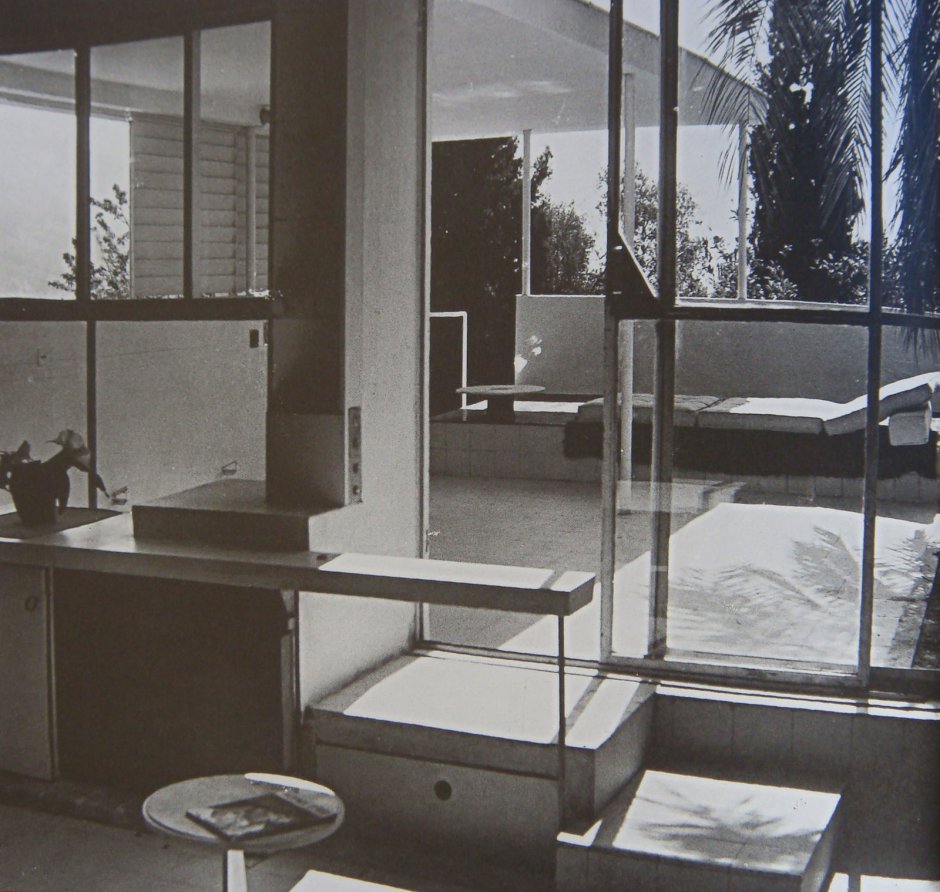
After completing her famous E-1027 (and falling out with Jean Badovici), Eileen Gray designed and built Tempe à Pailla between 1932 and 1934 above Menton in Castellar, not far from E-1027 (but away from the coast). The name, Tempe à Pailla, comes from a Provençal phrase meaning “time for a straw” or time for a rest after harvest).
Still in private ownership, the home is not available for touring, but one can gawk from the street (although parking is nearly non-existent!). Gray integrated Tempe à Pailla into the existing the hay barn at the location, perching her Modernism on top of local, stone vernacular, perhaps predating regional Modernism. Whereas E-1027 was a party house, Tempe à Pailla was more personal, more modest, and a bit more introverted.

Sutherland remained the property La Villa Blanche after adding an extension to the building, and the sign remains.




On August 27, 1965, Le Corbusier went for his daily swim off Cabbé beach in Roquebrune-Cap-Martin, France. His doctor warned him against such strenuous exercise at his age, but he waved the doctor away. While in the water, he suffered a heart attack. He made it back to the rocky beach, but struggled to pull himself to shore. Passerbys offered to help, but he waved them away. He failed in pulling himself onto the rocks and slipped into the water and drowned. He was 77.
After his wife died in 1957, Corbu buried her at the municipal cemetery in Roquebrune-Cap-Martin, a stunning hill-hugging resting place overlooking the Mediterranean. Corbu bought a plot for himself next to her and designed his own headstone, a miniature Brutalist structure. Colored enamel plates represented the sea and sun with seashells pressed into the cold concrete.
The hazy horizon seemed to say "the difference between materiality and nothingness is but a slow blur." A fly buzzed around us. We waved it away.


After Le Corbusier desecrated Eileen Gray's E-1027 house with his murals, what some have equated to architectural rape, he was banished from the grounds. However, Corbu had fallen in love with the locale (and the house) and, somewhat creepily, perched himself above E-1027 (architectural stalking?). He somehow convinced the owner of the nearby cafe to allow him to attach a cabana, a tiny log cabin, to the back of the cafe (with a special-access door to the cafe) and to build a small, five-unit boardinghouse for beach visitors. Corbu also built (repurposed?) a shed to work in when he stayed at the cabana.
Gray had a 'WTF?" response to Corbu's activities above her house.


