After I announced my retirement from the state, folks asked "Are you going to take a trip?" A trip? What a splendid idea! "Sure!" I answered, "I'm gonna go to Detroit!" To a tee, the response was: "
Detroit?!?! Really?!?!?"
Yes: Detroit! Really!!!
As you know, I adore street art. I'd been getting emails from
1xRUN about a recent street art show in Detroit, so I thought: "Let's go to Detroit!" In addition, Detroit sports the largest collection of Mies van der Rohe buildings in one location, grass-roots hipster entrepreneurship, and an old Austin friend who works with the city on revitalization projects (and who tempts me from time-to-time with dirt cheap Art Deco).
We all know the story: Henry Ford, race riots, white flight, manufacturing malaise. In 1950 the area thrived with 1.85 million Detroiters; today just 700,000 remain (with a continued downward trend). Furthermore, about 32 percent of Detroit families are below the poverty level. The city is a dinged and dented hull of its former itself.
Nonetheless, I found Detroiters proud and friendly. Admittedly, the place is at first disconcerting for someone from ever-growing and ever-gentrifying Texas. Detroit neighborhoods are cancered with empty lots and abandoned houses. It's not unusual to find an entire city block with a single sentinel house on it. However, the emptiness is oddly soothing. There's safety when the buffalo can gawk about the plains and see potential predators. Someone (the city?) mows the empty lots, adding to the sense of security.
These neighborhoods are slowly dying as the homeowners themselves die, the houses buried along with their caretakers. There are, of course, exceptions, where neighborhoods have survived or are coming back (one sports a Frank Lloyd Wright), but most, by my eyes, look like the one above.
Private "Property"
My friend encouraged me to drive east along the shorefront to where Detroit ends and the suburb of Grosse Pointe begins. It was sobering. On the Detroit side of the fence line, the neighborhood is in death throes. On the suburban side, the neighborhood was alive.
Detroit to the left; Grosse Pointe to the right (via Google Maps). Can you tell where one begins and the other ends?
Like many downtowns, Detroit's is thriving with culture and construction. Quicken Loans' Dan Gilbert bought more than a billion dollars of Detroit real estate for refurbishing and rebuilding. He's also a surprising aficionado of street art, commissioning the world's largest Shepard Fairey for one of his downtown skyscrapers (among other commissions.
Would I go back? Yes! There's the M
ovement techno festival every year (after all, techno was [arguably] invented in Detroit). There's more food to try out and more art to see (I didn't have time to gawk at Diego Rivera's mural or the art museum). More street art is added every year. And there's still the automotive museums to see.
Stay tuned for a subsequent post on Detroit street art.
mies van der rohe
Chicago-developer Herbert Greenwald commissioned Mies van der Rohe for an urban renewal project east of downtown called
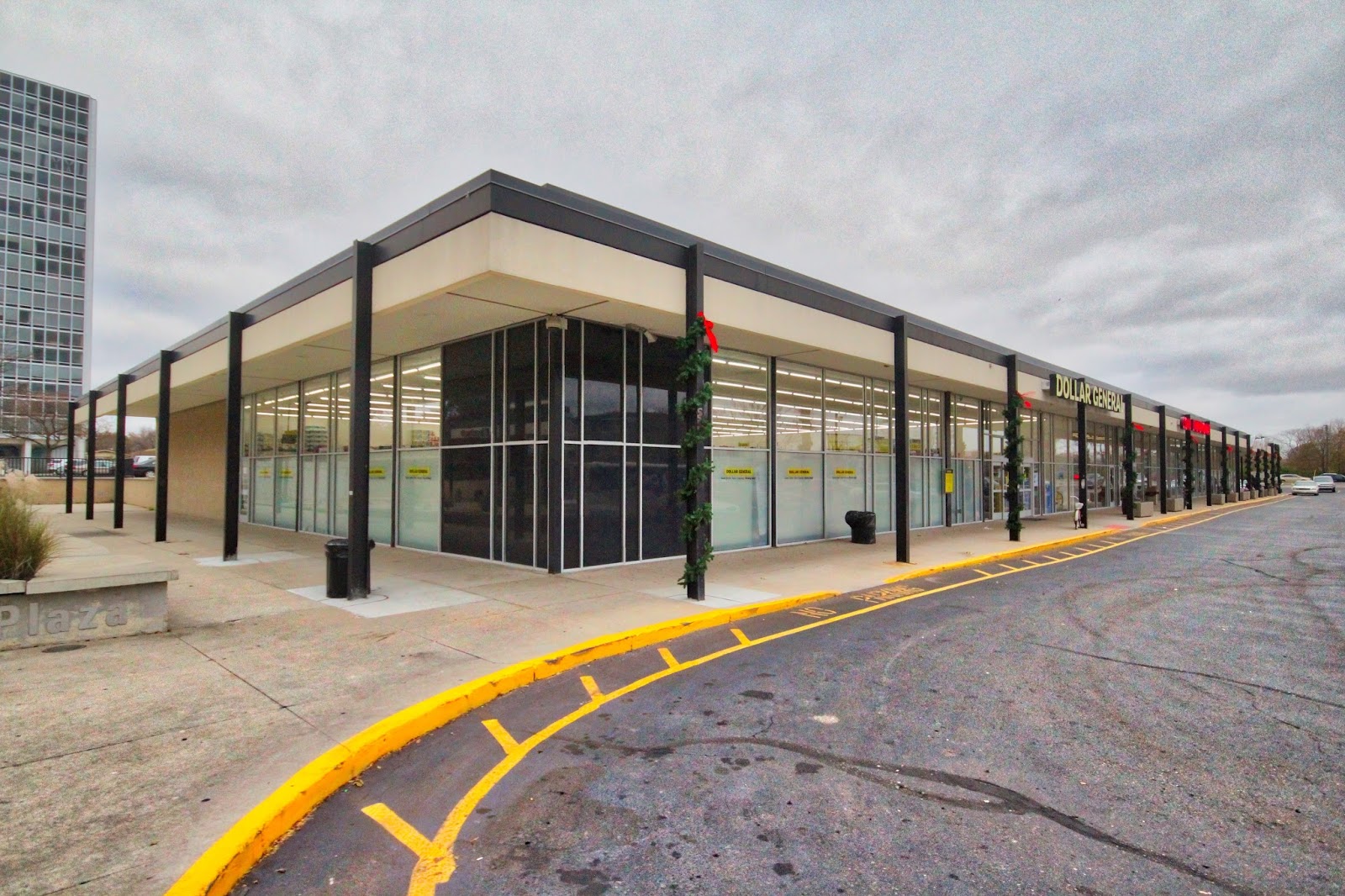
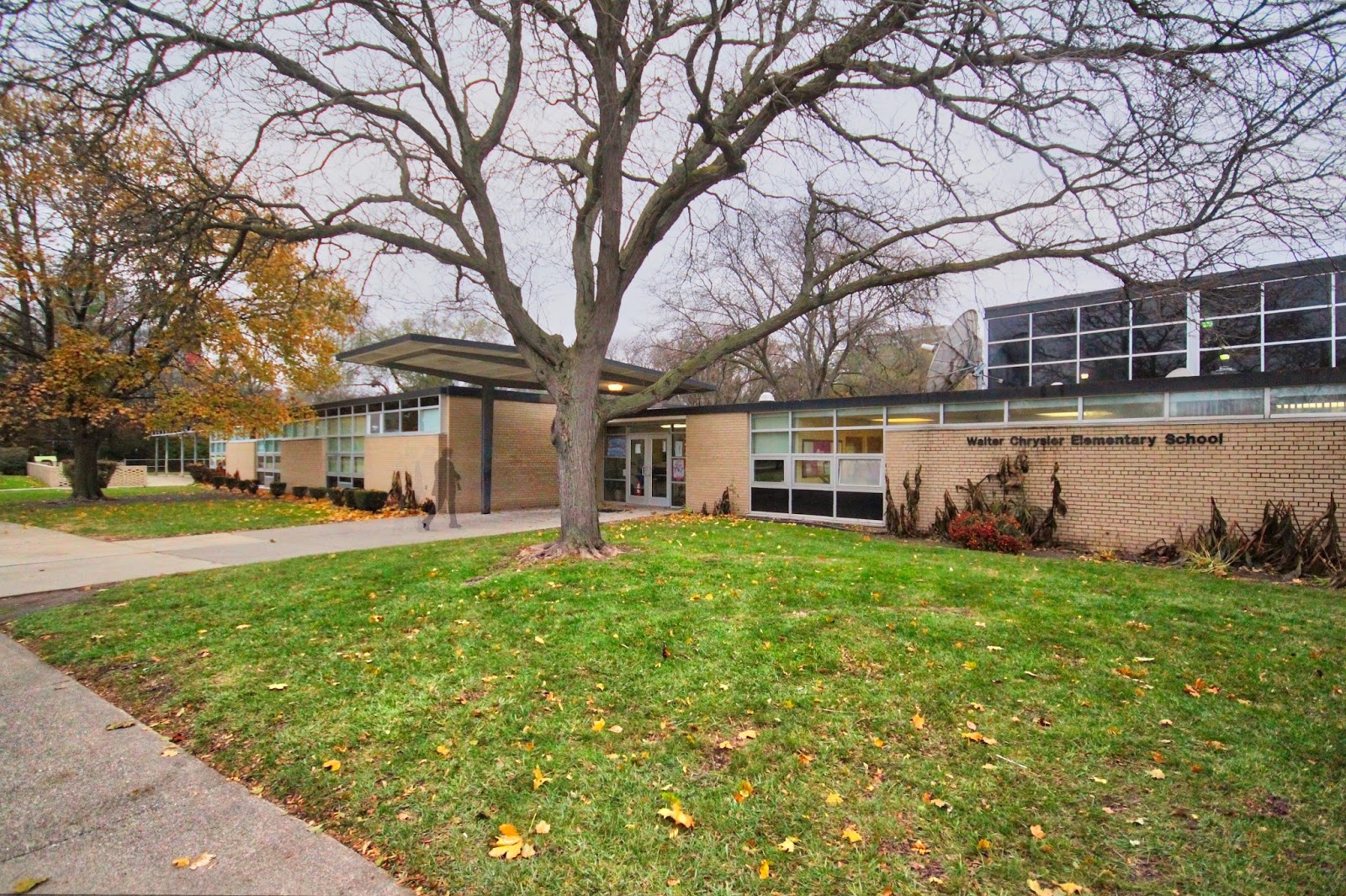
Lafayette Park. The project includes three high-rise apartment buildings, 162 tri-level townhouses, 24 bi-level court houses (houses with enclosed courtyards), and a large inervening park. There are other Mies-inspired buildings on the property (for example, the school and shopping center).
Lafayette towers are classic Mies, carrying the precedent from his residential towers in Chicago almost untouched to Detroit.
A Lafayette tower serves as a backdrop to Mies van der Rohe Plaza in the Miesian shopping center.
Detail of a Lafayette tower before a guard yelled at me for taking photos "NO PHOTOS ALLOWED!!!" I assumed is was because of the butchered paint job. Was the building originally black?
The Miesian shopping center.
The Miesian School.
Because there are so many of them, the townhouse count achieves the "Most Mies' in One Place" award. However, they are all of the same design. The integration of space and nature is admirable. These are "tri-level" because they have basements.
The Pavilion Apartments by Mies.
The Spirit of Detroit
hart plaza
Hart Plaza is where Antoine Laumet de la Mothe sieur de Cadillac landed in 1701 and established Fort Pontchartrain du Detroit. Isamu Noguchi designed this Brutalist park.
Entrance sculpture in Hart Park by David Barr. This is near where Martin Luther King, Jr. first gave his "I have a dream" speech.
Fountain in Hart Park
Monument to the Underground Railroad (gazing across the river to Canada).
guardian building
The Guardian is an ornate Mayan Revival Art Deco building where my friend offices. Designed by
Wirt Rowland and built in 1929, the foyer is a stunning over-stimulation of color and decoration.
michigan theater
Parking garage in an old theater!
If you look closely on the right, there are two kitties eating lunch. Some good folks feed stray and abandoned cats all over town.
frank lloyd wright
The following photos are from
turkelhouse.com:
The original buidling for the Detroit Institute of Arts is Paul Cret, who designed several buildings on UT campus, including the tower. Gunnar Birkerts designed the building most visible in the photo (which was later resurfaced by Michael Graves).
The Art Deco'd Detroit Historical Museum
The Park Shelton where Diego Rivera and Frida Kahlo stayed while Diego worked on his murals.
Nifty performance space cantilevered off of an old overpass that used to cross the railroad (now a bike trail).
Rail-to-trail shipping container architecture
Gorgeous Brutalism at the live music venue
Chene Park.
food
I had three primary goals for this trip: (1) see street art, (2) see the Mies van der Rohes, and (3) eat
Detroit-style pizza at its point of conception, the original
Buddy's. I was not dissappointed.
Zingerman's Coffee at The Guardian served up a life-rejuvenating latte.
Dime Store served up a fantastic special for me. Brunch all damn day!
I picked up a stunningly good bulgogi special at Chartreuse in the museum district. Yum!