Showing posts with label Germany. Show all posts

11.02.2024

renzo piana at the vitra design museum

The smallest architectural gem at the Vitra Design Museum is the Diogene. Designed and built by Renzo Piano between 2011 and 2013. the Diogene is named after the Greek philosopher Diogenes of Sinope ("Diogene di Sinope" in Italian). Diogenes is one of the founders of Cynicism (a root philosophy of Stoicism) who famously lived in a pithos, a large ceramic jar, while roaming the streets criticizing the excesses of Athens.

Piano is best known for the Centre Pompidou in Paris, The Shard in London, and the Whitney Museum of American Art in NYC (among others). Like many a starchitect, he has spent some time considering living efficiency with a focus on the smallest space for human habitation.

The Diogene sports a luxurious 7.5 square-meter (81 square-feet) wholly-contained, off-grid living unit meant for remote contemplation (presumably of the excesses of Athens and other metropolitan areas). The microcabin has solar cells for power, rainwater harvesting for water supply, and solar water heating. Interestingly, the building collects rainwater from gutters at the bottom of the building.

The exterior, clad in riveted aluminum, looks like something Elon Musk would sprinkle Mars with, but the interior is pleasantly warmed with wood and actually looks quite lovely. The windows are triple glazed for efficiency. Presumably the space is warmed with the "boiler" on the roof, transferring solar heat collected from the day to the interior at night. The interior includes a living space, a kitchen, a shower, and a composting toilet. The innards were not open for viewing during our visit (the photos below are from Vitra and Piano). 

The Diogene is a nifty little cabin, although I suspect its namesake, Diogenes, would rebel at its excesses compared to his clay pot.


9.28.2024

frank gehry at the vitra design museum

After a fire burned down half of the Vitra campus, they hired a number of budding architects to help rebuild, including one Frank Gehry. Gehry designed the museum as well as entrances to the factories and the gatehouse, completed in 1989. These structures were not only his first European buildings but also his first use of the curving, almost nonsensical structures that would turn into his signature style and starchitect status.

One thing I love about Gehry's buildings is that they are different through all 360 degrees. 


A peek over the fence at an entrance to the factory:

And here's the gatehouse:


6.08.2024

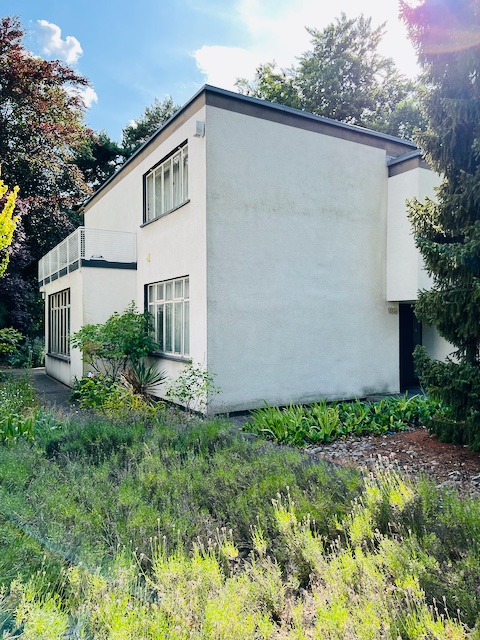
Lewin House, Walter Gropius and Peter Behrens (1928)

 
For this home on the outskirts of Berlin (Germany), Walter Gropius and Peter Behrens teamed up for the design. Finished in 1928, the design is crisp and clean with an almost-introverted facade. The rear is much more open to the outdoors. Privately owned, so not available for tours.

The house is in good shape, although the second, side-garage is a later addition. Love the controlled wilding of the front, side, and back yards.


2.04.2024

memorial to the murdered jews of europe (berlin)


Peter Eisenman designed this Holocaust memorial in Berlin with 2,711 concrete pillars of varying height across 200,000 square feet in downtown Berlin. An underground bunker holds the names of the about three million killed during World War II by Nazi Germany.  Dedicated in 2005, it has not aged well, primarily with what appears to be poor foundation materials since parts of the memorial are tiled helter-skelter and many of the pillars are being redone.

As a fan of cubism and Brutalism, I liked the display, but the impersonality of the installation results in many people not understanding what it is about. On the other hand, maybe that's what this display is about: some know what's "happening" with the exhibit while others have no idea or no curiosity to know more, kinda like the Holocaust at the time it happened.


1.27.2024

a visit to daniel libeskind's military history museum in dresden, germany

On the way from Berlin to Prague, we stopped in to gawk at Libeskind's addition to the Military Museum in Dresden, Germany. A short jaunt from the highway, we parked and walked to check out the building. We didn't have time to check out the museum's contents, but we were able to walk the grounds and get a few peeks inside (bathrooms! cafe!).

Libeskind is the king of borgitecture, and you can see why: his radical interventions are shocking but also somehow work. As we strolled the steps, I could hear the critics arguing about Dan screwing up an historical building physically as well as aesthetically; however, I was surprised (relieved?) to see that the front, jutting volume is simply attached to the original building like a remora attached to an old grizzled shark, retaining the original inside. Nice touch.