I've
been to Seattle before, but could only accomplish short side walks from the hotel since I was on business. I was on business on this trip, but since I was coming from Denver (instead of flying from Denver to Austin, spending the night, and then getting up the next day to fly to Seattle), I had a chance to enjoy a cold drizzly day tromping about town before meeting bidness obligations the next day. And, of course, when I had to be inside all day doing big boy stuff, it was sunny and gorgeous. That's the roulette wheel of Seattle.
I started the day at the Biscuit Bitch with a hearty (but not heart-healthy) meal and then marched over to the grounds of the 1962 World's Fair to gawk at the Space Needle and Frank Gehry's. After that I visited the stunning Olympic Sculpture Park on the north side of downtown. I then checked out several Olson Kundigs (and enjoyed a Stumptown) before paying respects at Rem Koolhaus's central library. All in all a cold, rainy, and great day!
The Needle, designed by
John Graham and Company (although
Victor Steinbrueck, an architectural consultant on the project, claims design credit) was painted Astronaut White and is topped by a rotating restaurant so perfectly balanced that it is powered by a 1.5 horsepower motor.
The Federal Science Pavilion by
Yamasaki:
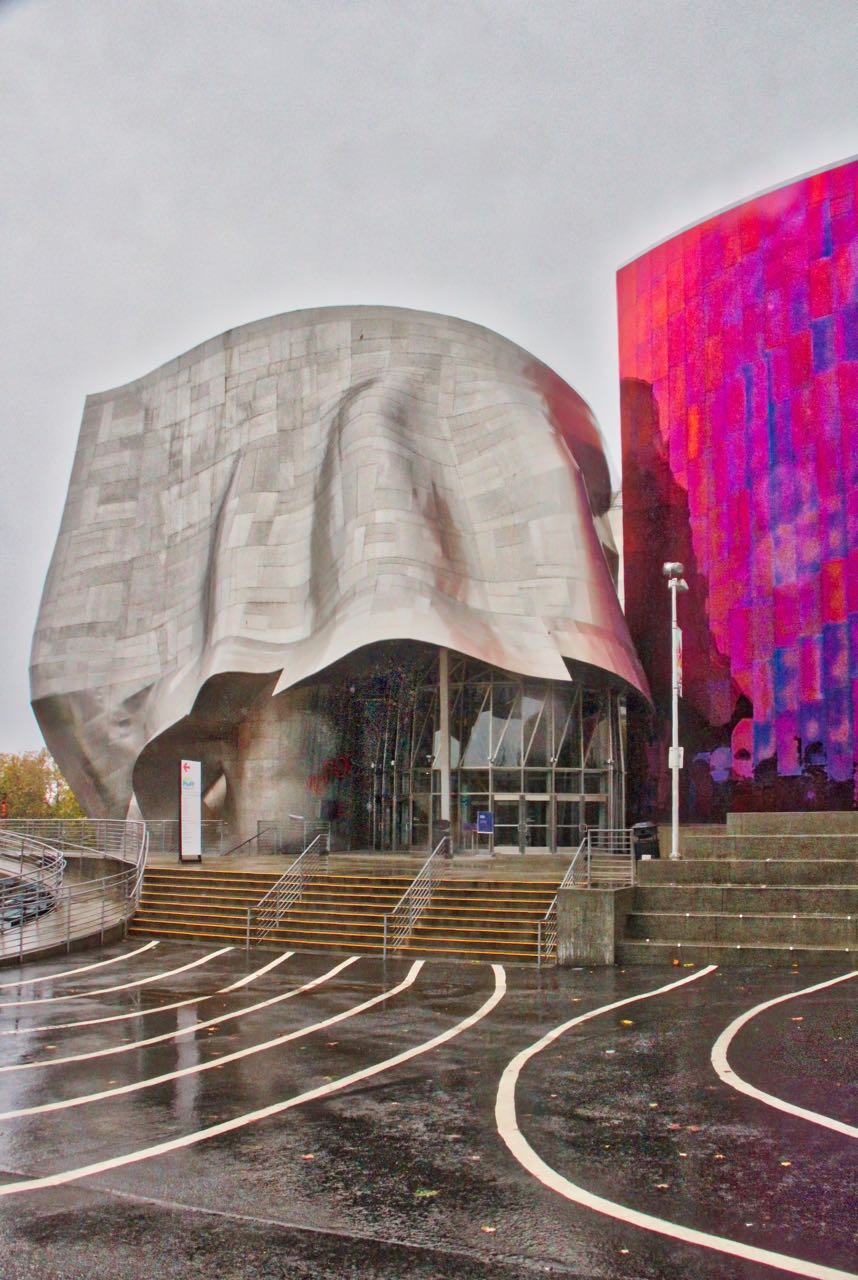
Based on the photos of Frank Gehry's Museum of Pop Culture (originally called the Experience Music Project) completed in 2000, I thought it was a derivative project. However, seeing it in person has changed my mind. And like any classic Gehry's, this thing is gorgeous and fascinating from every angle. A unique aspect of this building is how it successfully engages the street at the human scale. I'll need to come back and see it on a sunny day!
The train travels through the middle!
On the north side of downtown on a challenging, sloped lot sliced by a four-lane road and two train tracks is Olympic Sculpture Park. The park zigzags down the slope up and around the road and tracks to the bay in the most beautiful and ingenious way, creating epic views and cozy crooks and crannies for sculpture. The project was designed by
Weiss/Manfredi and opened in 2007 (you can tell they are proud of it since it is still
the splash photo on their front page). This is a must see in urban parkery.
If I ever start my own archictural movement, it will be defined by alleytecture:
I hiked out to several Olson Kundig structures in town. OK are one of my fave architects of today. Where they really excel (imho...) is in cabins and houses. Sadly, their design principles don't seem to export well to larger commissions, at least not in an immediately identifiable way.
A Olson Kundig project, 2nd and Pike, under construction downtown.
The mid-rise Art Stable does successfully transfer the OK aesthetic to a larger building. Note the enormous windows that can hinge outwards.
Stormwater harvesting...
STUMPTOWN!!!
The weather was deteriorating quickly at this point, but I had to pay respects to Rem Koolhaus's Seattle Public Library.
View out my hotel window.
SaveSave