8.20.2016

haiku for the book "Weissenhof 1927 and the Modern Movement in Architecture" by Richard Pommel and Christian F. Otto


go to Weissenhof
to see an amazing set
of Modern houses

This is a remarkable book, but not in the sense of you-need-to-rush-out-and-get-this-damn-thing-as-soon-as-possible but in the sense of where-the-hep-did-these-guys-find-so-much-information. It's clear that Germans don't throw anything away and that they protect their paperwork even during world wars.

Opened in 1927, Stuttgart's Weissenhof is the greatest single collection of early Modern architecture in the world. Chicago is great, Los Angeles is amazing, Paris is pretty in springtime, but for an individual development with nearly all the big names of the time, this is the real deal. Mies van der Rohe, Le Corbusier, Mart Stam, Walter Gropius, Scharoun, Bruno Taut, Max Taut, Behrens, J.J.P. Oud, and others contributed to the exhibition.

Mies van der Rohe was the grand architect of the project, laying out the development, recruiting and fighting for a Modern direction, and designing several of the buildings. When the housing development opened up, more than 500,000 visitors tromped through its streets to see the new architecture for themselves.

The project was a power of wills. The city wanted a humble demonstration of housing with an emphasis on local architect; Mies wanted an avant-garde display of international Modernism. Mies and the avant-garde won.

The project was not without its drama. Mies excluded Adolf Loos from the project, something Loos remained bitter about (although Loos blamed the mayor). The authors speculate that Loos' designs had become embarrassing, such as his goofy Post-Modern-before-there-was-such-a-thing-as-Post-Modern proposal for the Tribune building in Chicago. Loos was too much of a wildcard for the Weissenhof. Mies was attempting to consolidate the movement.

With many different architects designing so many different buildings, Mies needed to link the projects together visually. He did this by encouraging the use of an off-white paint for most of the surfaces with color allowed to highlight distinct parts of the architecture. And many of the architects used color to great effect. Even Gropius, recently influenced by van Doesburg's de Stijl movement, colored his work at the Weissenhof. Nevertheless, white remained the Modernists' color of choice, "...the tabular rasa reshaped only by pure form, space, structure, and function." The unifying use of white at the Weissenhof "led the way in the new direction" in the use of color (or lack thereof) in the International Style.

Besides collecting many of the best architects in a single place for public viewing and establishing white as the non-color of choice for Modernism, the Weissenhof is important for other reasons. For example, Corbusier's villas at the Weissenhof were the "pretext of the announcement" (Corbu's words) for his article "The Five Points of Architecture" (pilotis, roof garden, free plan, ribbon window, and free facade).

After the opening, people expressed concerns about the designs, particularly how open they were on the inside as well as to the outdoors, thus, in the minds of the critics,  presenting a threat to traditional family life. Detractors described the houses and apartments as anti-children because of their clean surfaces and machine-like perfection (echos of these complaints are still heard today). After the exhibition, Stuttgart debated what to do with the buildings. One prominent local stated that the Weissenhof had "produced nothing of aesthetic value". Nevertheless, the city was able to easily rent everything in short order except Corbusier's villas due to concerns that all the natural light and outdoor space would be bad for people's health. Shortly before World War II, the German army considered razing the development to build a base, but thankfully decided on another location.

Although the Weissenhof suffered damage during WWII, losing several houses, somehow the bombs missed most of the real gems such as Corbu's two villas and Scharoun's swooping house (perhaps the Gawds are Modernists as well!). Nonetheless, houses by Gropius and the Tauts were destroyed and other greatly modified. Since the war, many of the buildings have been rebuilt or remodeled back to their original plans.

I'm not sure what Mies the Man would have thought about this book, but here's what Mies the Cat thought:


There you go...

In about a month, the bride and I will be in Stuttgart to see the Weissenhof for ourselves. Expect a report back soon!
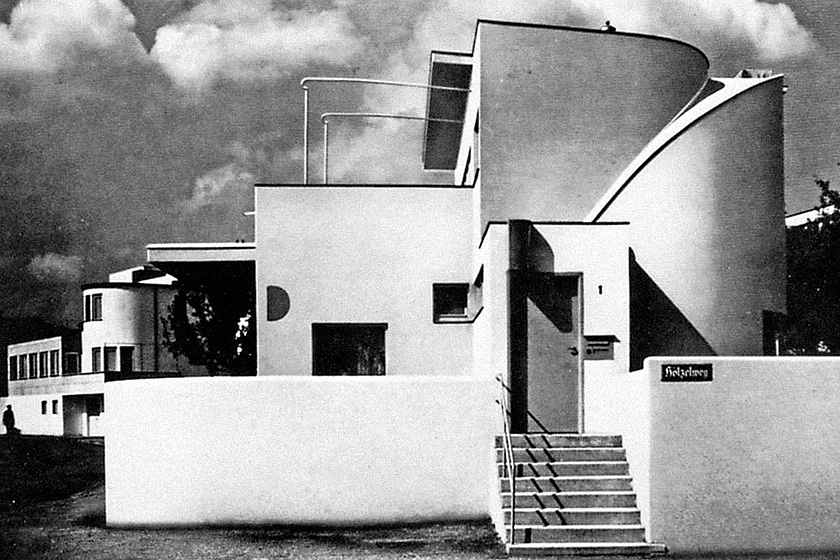


This Scharoun house is one of my top-ten early-Modern houses.


Detractors of the project produced this postcard poking fun at the Meditteranean influence on Modernism.


One of Corbu's villas


SaveSave

8.18.2016

The Batman likes Mies van der Rohe. A lot.


So Batman v Superman: Dawn of Justice pops up on in iTunes. The bride isn't interested in watching because the reviews have been bad. She heads down to Louisiana yesterday on a bidness trip, so I rent the movie. A couple things...

1. Although not close to being the best movie I've seen, it was actually pretty good. After all, it's a superhero movie. We're not talking high cinema. It was probably too ambitious (and too long), but it genuinely surprised me in a few places. Probably its biggest problem is that the whole superhero genre is getting long in the tooth. We've seen this story arc many times before.

2. The Batman (more accurately Bruce Wayne) lives in a black (of course) version of the Farnsworth House! I called it during an interior shot of the bedroom ("Hmmm" I hmmm'd. "That sure looks like a black version of the Farnsworth House. Wouldn't it be cool if...") and then took a screen shot (literally!) of the house when they panned out. Gorgeous! The black Farnsworth sits on a lake instead of near a river and, in a later scene, has garage/carport out back.

Turns out the house is real and north of Detroit. According to this post, it was built for the movie. That's stunning (that they built the house for the movie and the house itself)!


SaveSave

8.14.2016

dancing with architecture: edmund, ada, sulphur, norman, and oklahoma city, oklahoma


edmund

Back in Oklahoma for bidness (water-water-water), I was able to steal some time in the mornings and evenings to see some stuff in the area (architecture is everywhere!). I was pleased to stop in to gawk at Bruce Goff's Hopewell Baptist Church (1950) in Edmund. The building's been in jeopardy due to asbestos insulation and a leaking roof, but, as you can see, it has a new top (thanks to the good folks at Jenco Roofing Company). Peeking in the windows, the place is gutted. Hopefully, the congregation will be able to fully restore (and use) the building. Both a threat (redevelopment?) and an opportunity (more parishioners?), greater Oklahoma City seems to be stretching in this direction. Would love to see the inside some time.

Note the blue glass in the "bell tower." The congregation built the church for $20,000.


ada

Ada is a quaint little town about 1.5 hours south-southeast out of Oklahoma City with a small college and a national environmental lab. The mayor is a water professor from the college! There's not much architecturally, but I stumbled across some good stuff during my morning and evening strolls about town.

Nice Deco post office and federal courthouse combo:


The Sugg Clinic is a gorgeous Art Deco building in town well worth a looksee:


The fire station is also a lovely example of Art Deco:


McSwain Theatre is nicely restored and active:


Nice little International Style office building (with a water theme!):


I see (or at least I think I see) the influence of Goff in the area, such as at this Catholic Church:


The water tower one morning:


misc:


The Chickasaw Nation Pavilion by Fitzsimmons Architects

Robert S. Kerr family homestead.

sulphur


I took a look at a map to see what was in the area to maybe go gawk at one the evening, and lo and behold, a mere 30 minutes away, was Sulphur! I hooked up with an old college buddy who was also at the meeting, and we high-tailed it down to Sulphur right at the end of the conference, ties, suit coats, and all.

Back in the early 1900s, Sulphur, like many towns in the US that had saline springs or wells, was a resort destination where people could partake of the waters in the hopes of curing various ailments. Mineral water was a booming business up until the 1940s (or so) when the Feds required science to back the various medical claims as to the curative powers of the waters. Since there was no science, many resorts, no longer able to make ludicrous claims, faded away. The Vendome Well (and Sulphur in general) was no different.


Fortunately, the well is still there as part of the Chickasaw National Recreational Area (formerly the Platt National Park). There's a slight scent of sulphur when you approach the well; nothing offensive, but you know it's there. I sipped from a squirting water fountain at the well site; just a hint of salinity (the water is probably just north of fresh at 1,000 ppm of total dissolved solids). As you can see from the photos above, there used to be a pool next door with a water slide and diving board. These days, the flow heads down a small drainage to a nearby creek. According to my cohort, the flow has slowly declined over the years. The city shuts the well down at night these days to preserve pressure.


Nearby in the park are various springs, including Bromide Springs:


Sulphur-loving bacterial strands!

Which has also been around awhile:


Befitting a resort town, Sulphur has a large resort hotel called The Artesian.


Neat card showing the front and backside of the hotel. Note the flowing artesian well in the courtyard.


This card fuses the front and backside into one large building #falseadvertising


The hotel was still there and operational until a few years ago when it was razed to build the new Artesian:


On one hand, sad to have missed the original Artesian and for it to be gone; on the other hand, nice that the Artesian moves forward into a new century.

Next door is a modern visitor center by F+S+B: 


greater ada

On the last day of the conference we went on an afternoon field trip (you know, the hottest time of the day) to learn about the aquifer in the area and Ada's water supply (and also the source of the wells and springs in Sulphur).


Ada's water supply comes from a spring issuing from the Arbuckle-Simpson Aquifer (my pal is an expert on the aquifer). It's an unusual aquifer in that it is thermally and chemically vertically homogenous (down to 3,000 feet deep). For those of you in the know, it's like the Edwards Aquifer turned on its head. The city's water supply pulls directly from the outfall of the spring which is then gravity fed to Ada. The spring is (sadly) covered with a concrete suspension cap, presumably to keep dead critters and naked frat boys from sullying the city's water supply.

Everything is painted green.


norman

On the way to the airport, I stopped in to potentially gawk at the remnants of one of Goff's greatest works, the logarithmically spiralling Bavinger House (1955):

Photo from Wikipedia in better days.

A windstorm damaged the structure and the owners, in an apparent tussle with preservationists, bulldozed the entire house earlier this year. That, my friends, is a serious bummer. You can't see anything from the street except a closed gate and two posts with video cameras.

photo from here

photo from here


 Just to the south of the Bavinger property is a Goff-like designed by (and for) a Goff associate, William Wilson.


Next to it is another Wilson-designed space, a garage/storm shelter/apartment:


oklahoma city

Probably not worthy enough to list OK City on its own, but here's a shot of the airport with what I would call a Goff-inspired design:


SaveSave